
Vostok Amphibia History:
How the Legendary 200m Soviet Dive Watch Was Created
Discover the history of the Vostok Amphibia, the legendary Soviet 200m dive watch.
Learn how Mikhail Novikov and Vera Belova engineered its unique case, crystal and sealing system.

In 1967, a car wheel slowly began rolling toward a wristwatch.
“10… 7… 5…”
The crowd watched in silence.
“3… 1 meter…”
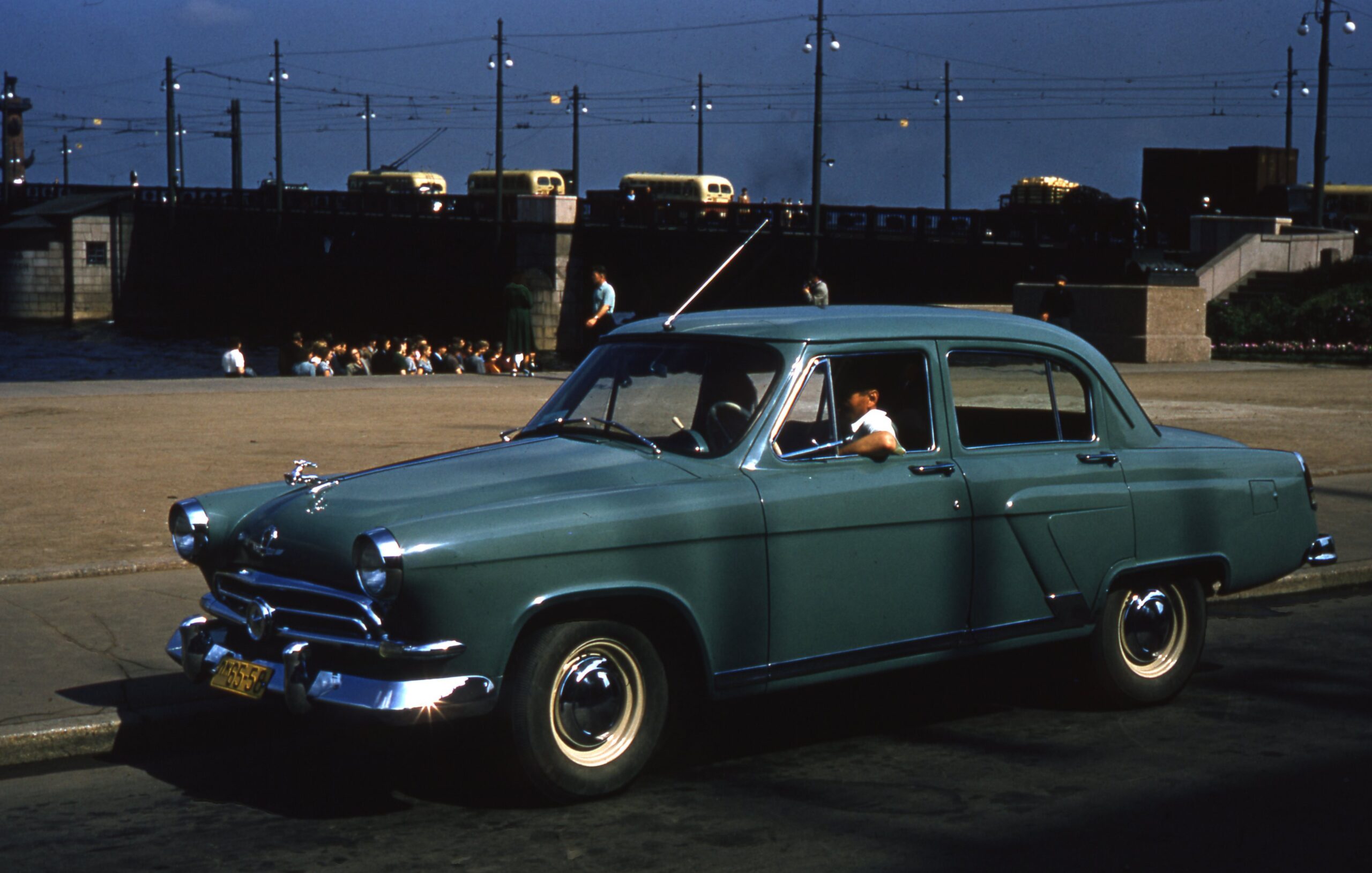
Then the wheel of a Soviet Volga rolled directly over the watch.
The demonstration was designed to show what the new watch could withstand. But the real story of the Vostok Amphibia is much more interesting than a car rolling over a watch.
Behind the seemingly simple stainless-steel case was a completely new approach to water resistance. The engineers had to develop a special crystal, a new sealing system, new materials and manufacturing techniques that did not simply copy existing Swiss designs.
The result was the Amphibia — a mechanical dive watch designed to withstand pressure equivalent to a depth of up to 200 meters.
More than half a century later, the basic engineering ideas behind the Amphibia remain one of the most recognizable achievements of the Chistopol watch factory.
From Chistopol to the Amphibia
The history of Vostok goes back to 1941, when equipment and workers from the Second Moscow Watch Factory were evacuated east during the Second World War.
The equipment eventually reached Chistopol, a city on the Kama River in what is now the Republic of Tatarstan. In April 1942, the newly established factory began producing equipment for the Soviet Army.
The factory initially operated in buildings that had previously served as schools, an institute, a college and a library. Despite the extremely difficult conditions, production began remarkably quickly.
In 1943, the factory started producing civilian watches, including the Kirovskie men’s wristwatch.
Over the following decades, the Chistopol factory developed a reputation for durable mechanical watches and precision instruments. In 1965, it became an official supplier of watches to the Soviet Ministry of Defense.
The experience gained from military watches would soon lead to something new: a watch specifically designed for serious water resistance.
According to the factory’s own historical account, the Amphibia was introduced in 1967 with water resistance up to 200 meters.

Why was the Amphibia needed?
By the 1960s, mechanical diving watches already existed in Switzerland and elsewhere.
The Soviet designers therefore faced an unusual challenge.
They needed a watch that could:
- remain sealed under high water pressure;
- withstand significant temperature changes;
- survive impacts and demanding use;
- remain mechanically reliable;
- be manufactured using the equipment available at the Chistopol factory;
- and, importantly, use an original engineering solution rather than simply copying an existing patented design.
Mikhail Novikov, who headed the factory’s New Design Bureau and worked on the Amphibia project, later explained that the task was not simply to find a waterproof construction.
The goal was to create a solution that could perform as well as the best foreign examples while being technically and economically suitable for Soviet production.
That meant starting from the fundamentals.
Almost every major element of the watch case had to be reconsidered.
Why the name “Amphibia”?
The name was chosen by the factory’s employees during an internal competition.
“Amphibia” referred to an amphibian — something equally comfortable on land and in water.
It was an unusually appropriate name for a watch whose entire purpose was to bridge those two environments.
The name also became inseparable from the engineering concept behind the watch.
The Amphibia was not simply a conventional mechanical watch placed inside a waterproof case. Its case, crystal, gasket and back were designed to work together under pressure.
The secret of the Vostok Amphibia crystal
At first glance, the crystal of an Amphibia does not look particularly unusual.
That is exactly what makes its engineering interesting.
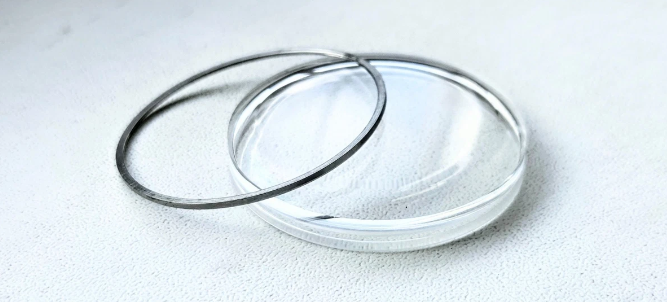
The crystal has a specially calculated cross-section and is considerably thicker than the crystal used in ordinary watches of the period.
According to the Amphibia designers, the crystal was designed to withstand pressure of around 20 kg/cm² — several times the pressure exerted by a typical car tire on the road.
Under pressure, the crystal does not simply behave like a rigid piece of glass.
It bends.
The Amphibia crystal can deform by approximately 0.5 mm under high pressure. That deformation was not merely something the designers had to tolerate. It was incorporated into the sealing concept of the case.
As external water pressure increases, the crystal presses more firmly into the case and helps maintain the seal.
This is one of the most distinctive features of the Amphibia’s engineering philosophy: pressure becomes part of the sealing mechanism rather than simply an enemy that the case has to resist.
The geometry had to be calculated very carefully.
The crystal had to deform without touching the hands inside the watch, while maintaining a reliable seal around its perimeter.
Even seemingly small manufacturing imperfections could become a problem.
The edge of the crystal had to be extremely precise, and scratches or irregularities around the sealing surface could compromise the result.
The designers therefore developed a special manufacturing process in which the crystal was not simply molded but subsequently ground to achieve the required dimensions and finish.
A gasket designed for pressure
The same attention to detail was required for the rubber gasket.
A gasket may sound like one of the simplest components of a watch.
For a high-pressure dive watch, it is anything but simple.
The Amphibia gasket was thicker than a conventional watch gasket. Under approximately 20 atmospheres of pressure, the rubber could be compressed by roughly 20–30 percent.
The challenge was not simply to make the rubber compress.
It had to return to its original shape after the pressure was removed.
It also had to continue working through temperature changes and repeated exposure to pressure.
Ordinary rubber was not sufficient.
The designers spent considerable time selecting the right material and manufacturing method. At one point, they even experimented with treating the rubber using an ionic process — a technology associated with demanding technical applications.
The gasket itself was produced from raw rubber and then cut to the required dimensions at the factory.
This attention to materials was crucial.
The Amphibia’s water resistance was not the result of a single “magic” component. It came from the interaction between the crystal, gasket, case, crown and case back.
The stainless-steel case was another challenge
The Amphibia was also notable for its stainless-steel case.
At the time, traditional watch cases were commonly produced from brass. Stainless steel offered important advantages: greater strength, durability and resistance to corrosion.
But stainless steel was much more difficult to manufacture with the equipment available at the factory.
The first attempts to produce the Amphibia case were not straightforward.
The lugs — the parts connecting the case to the strap — repeatedly broke during manufacturing.
Engineers experimented with different production methods and eventually developed a multi-stage manufacturing process.
There was even a problem with the particular grade of steel required.
According to the designers, the necessary steel grade was not yet produced domestically when the Amphibia was being developed, so a new specification had to be introduced into the Soviet GOST standards.
The result was a case that looked relatively conventional from the outside but was fundamentally different from an ordinary watch case.
The screw-down crown and rotating bezel
The Amphibia also introduced features that later became strongly associated with Vostok watches.
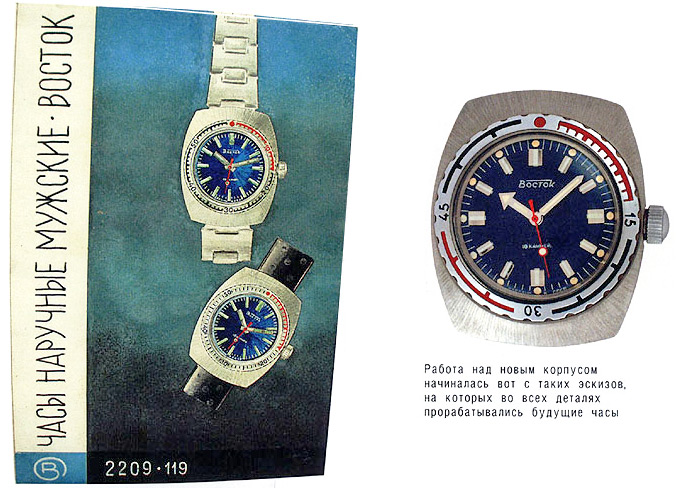
One of them was the screw-down crown.
Another was the rotating timing bezel.
Before entering the water, a diver could position the “0” marker on the bezel opposite the minute hand.
As time passed, the position of the minute hand relative to the bezel indicated how long the diver had been underwater.
The rotating bezel later became a familiar feature of many Vostok models.
The Amphibia was also the first Chistopol model to introduce this rotating timing system on such a broad scale.
The case back was specially designed as well.
Instead of the approximately 0.5 mm thickness used on ordinary watches, the Amphibia back was around 1 mm thick, and even the screw securing the back was strengthened.
Every component contributed to the same goal: reliable performance under pressure.
The famous car-wheel test
So what about that famous Volga rolling over the watch?
It is one of the most memorable stories associated with the Amphibia — but it is important to understand what the demonstration actually meant.
The car wheel demonstration was a durability demonstration, not a scientific test of the watch’s 200-meter water resistance.
Mechanical pressure from a car wheel and hydrostatic pressure from water are fundamentally different.
In fact, the water pressure experienced by a watch at its maximum rated depth is considerably greater than the pressure exerted by a typical car tire on the road.
The real engineering achievement of the Amphibia was therefore not surviving a car.
It was surviving underwater pressure while maintaining the integrity of the case and protecting the mechanical movement inside.
Amphibia and the evolution of diving-watch standards
The Amphibia’s engineering was significant enough that its designers later stated that their experience contributed to changes in international standards for diving watches.
One of the requirements concerned pressure applied perpendicular to the crown or pushers while the watch was underwater: the construction had to prevent moisture from entering the case.
The Amphibia was designed to meet this requirement.
This illustrates an important point about the watch’s development.
The goal was not simply to make a watch that could survive a particular test.
The engineers were developing a complete system for maintaining water resistance under real underwater conditions.
The NVCh-30: a military Amphibia
The 200-meter Amphibia was not the end of the story.
The Soviet Navy also required watches capable of operating at even greater pressures.
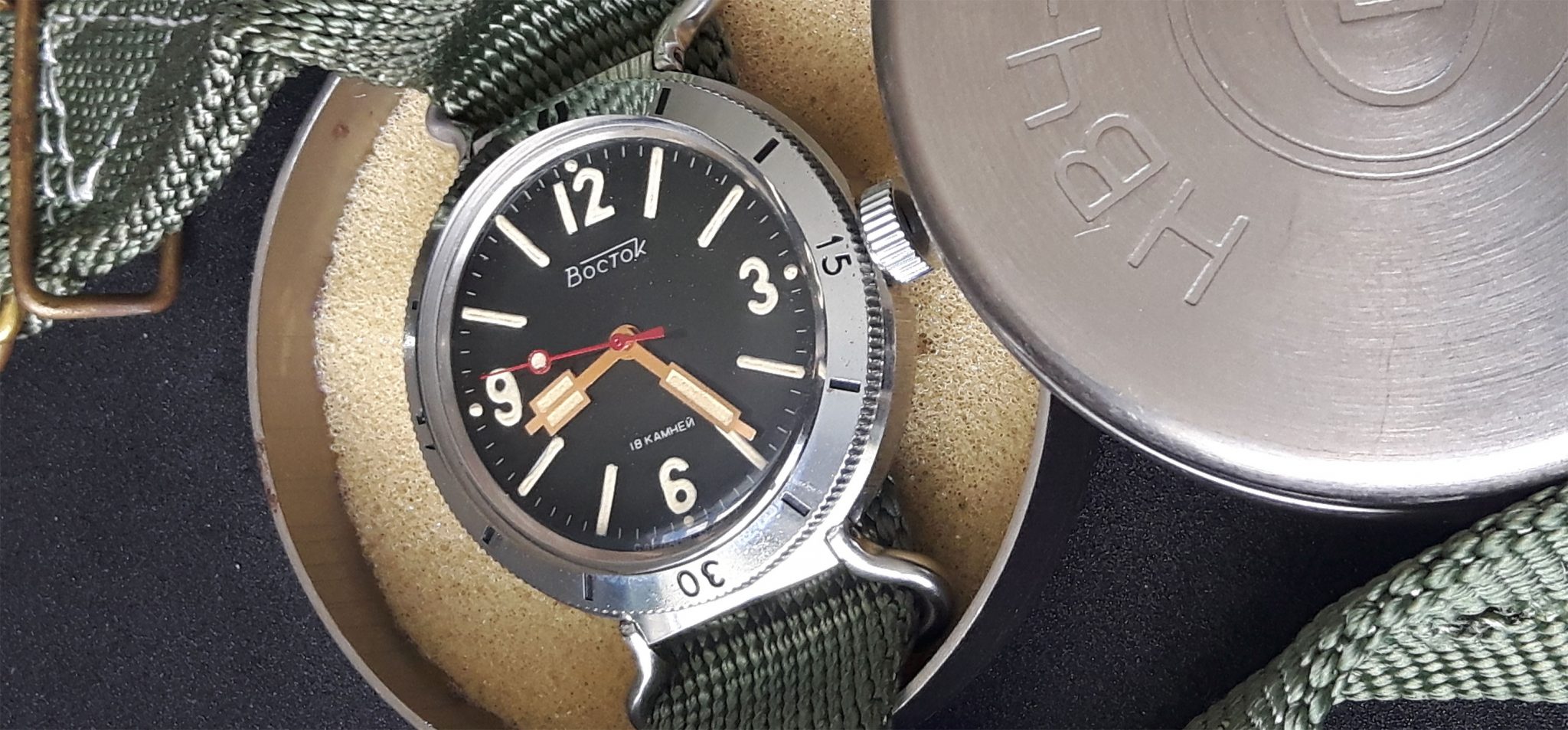
This led to the development of the NVCh-30, a military modification of the Amphibia designed for approximately 30 atmospheres of pressure.
The construction was reinforced with a different crystal configuration and a thicker case back.
The watch was subjected to an extensive testing program.
The tests did not focus only on the movement or case. Even the watch strap and its fastening system were tested for durability.
The NVCh-30 became particularly important for divers and combat swimmers who needed a reliable mechanical watch in demanding underwater conditions.
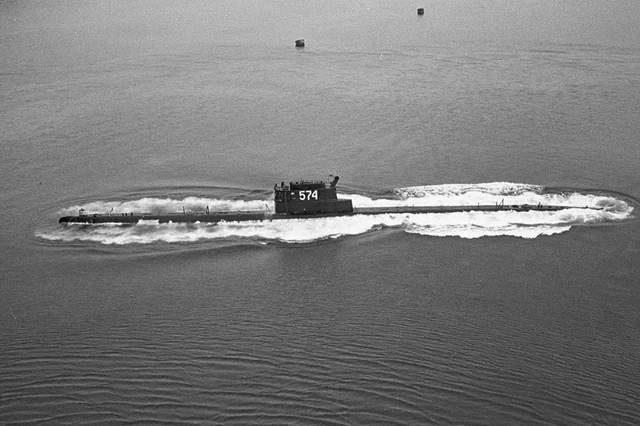
Tested during naval exercises
Some of the most remarkable Amphibia testing took place during Soviet naval exercises in the North Sea.
A submarine descended to approximately 120–130 meters, simulating an accident.
The exercise involved rescue ships, a large floating crane, diving bells, decompression chambers and a team of divers.
The divers working at depth wore the watches during the exercise.
A group of six sailors was eventually brought up as part of the rescue procedure.
The Amphibia watches successfully accompanied the divers during the operation.
The irony was that deep-water divers did not necessarily need a wristwatch for every task at such depths. They maintained radio communication with the surface, and their equipment made checking a wristwatch difficult.
For scuba divers and combat swimmers, however, a dependable mechanical dive watch was much more practical.
From the Soviet Navy to space
The story of the Amphibia did not remain underwater.
The watch also became associated with the Soviet space program.
The famous Soviet cosmonaut Georgy Grechko owned a Vostok Amphibia, and Vostok’s own historical material states that an Amphibia accompanied him during the Soyuz-17 mission and at the Salyut-4 space station in 1975.
It is a fitting contrast.
The same basic watch concept was created for environments of extreme pressure underwater — and was subsequently associated with an environment where there is essentially no atmospheric pressure at all.
That contrast became part of the Amphibia legend.

Why the Amphibia still matters today
The most interesting thing about the Vostok Amphibia is that its history is not based on luxury materials or complicated decoration.
Its appeal comes from engineering.
The watch was designed around a simple question:
How can a mechanical watch remain reliable when the environment becomes hostile?
The answer involved dozens of seemingly ordinary components working together:
- a specially shaped crystal;
- a carefully engineered gasket;
- a stainless-steel case;
- a reinforced case back;
- a specially designed crown;
- a rotating timing bezel;
- carefully selected materials;
- and manufacturing methods adapted specifically to the requirements of the design.
This philosophy became part of Vostok’s identity.
The Chistopol factory continued concentrating on mechanical watches designed to maintain accurate operation under demanding conditions — including changes in temperature, pressure and mechanical shock.
The Amphibia today
More than 50 years after its introduction, the Vostok Amphibia remains one of the most recognizable Russian mechanical dive-watch designs.
Modern Amphibia models preserve the characteristic engineering heritage of the original concept while offering a wide range of case shapes, dials, colors and mechanical configurations.
The collection now includes classic-looking models, automatic versions, 24-hour designs and numerous interpretations of the original Amphibia aesthetic.
That variety is part of what makes the watch interesting to collectors.
Two Amphibia watches can share the same fundamental design philosophy while looking completely different on the wrist.
And that is perhaps the most remarkable part of the Amphibia story.
A watch created in the Soviet Union in the 1960s was not designed to follow fashion.
It was designed to solve a problem.
More than half a century later, that solution remains recognizable.

The Vostok Amphibia legacy
The famous photograph of a car wheel rolling over an Amphibia is easy to remember.
But the real achievement is hidden beneath the surface.
It is in the crystal that bends under pressure.
In the rubber gasket that was developed specifically to recover its shape.
In the stainless-steel case that required new manufacturing techniques.
In the reinforced case back.
In the rotating bezel.
In the military NVCh-30.
In the divers who wore Vostok watches during naval exercises.
And in the engineers Mikhail Novikov and Vera Belova, who had to create an original solution when simply copying an existing foreign design was not an option.
That is why the Vostok Amphibia is more than a vintage-inspired mechanical watch.
It is a piece of Soviet watchmaking history that is still being produced, worn and collected today.
Explore our collection of authentic Vostok Amphibia watches and discover the designs that continue this remarkable story.